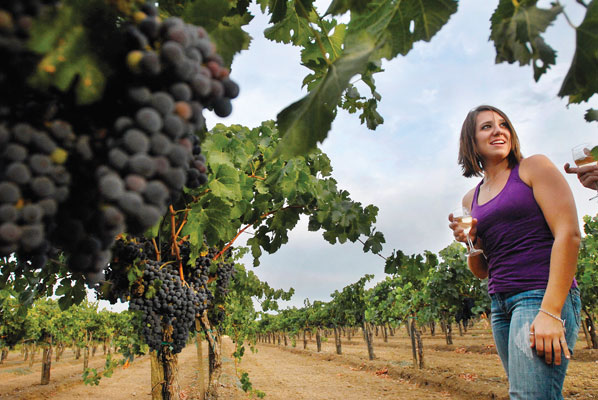
It’s a Friday night, and people are winding down the week by
sipping wine while leisurely picnicking, listening to live music
and enjoying views of a lush, green vineyard.
It’s a Friday night, and people are winding down the week by sipping wine while leisurely picnicking, listening to live music and enjoying views of a lush, green vineyard. Where might this idyllic setting be? Not Napa. Not Paso Robles. Right here in South County.
“When anybody says ‘wine’ to anybody outside of California, they think of Napa Valley,” said George Guglielmo, winemaker, viticulturist and co-owner of Guglielmo Winery in northeast Morgan Hill. “As an industry in this valley, as we improve our production techniques, I think we will be recognized for the quality of wines that we produce in the Santa Clara Valley. We do need to be recognized more as a unique American viticultural area.”
Seventeen wineries lie within minutes of Morgan Hill, San Martin and Gilroy, but south Santa Clara Valley faces challenges in marketing itself as a new wine country.
Vinegar Alley
In the early 1900s, Santa Clara and Napa counties were the two earliest premier grape-growing regions in California. Vines were first planted in Gilroy by Italian immigrants who settled along Hecker Pass Highway because the rich soil and warm climate reminded them of their homeland. The nearly half-dozen wineries along the winding highway were small, family-owned operations quietly making many of the traditional red wines from Burgundy. At Live Oaks winery, wine was sold by the half-jug and tastings were offered in shot glasses.
“It was an old Italian style of making wine,” said Vic Vanni, owner of Solis Winery on Hecker Pass Highway. “It wasn’t super-high quality, and it was very inexpensive.”
Meanwhile, Napa was exploring new grape varietals and revving up its marketing engines.
“Napa in the ’80s and early ’90s really took off,” he said. “We were behind the curve in this area. It took a lot longer for us to get on board with the new styles.”
South County’s wine industry is breaking from tradition thanks to a younger generation taking over the established wineries and countering the lingering perceptions that have led one wine critic to call the Hecker Pass area “Vinegar Alley.”
Guglielmo’s family-owned winery has certainly seen a fluctuation in total acreage and the number of wineries in South County since his grandfather started Guglielmo Winery in 1925.
“From the early ’70s on, it started up as a hobby kind of thing. You travel around and see a lot more small vineyards than before,” said Guglielmo, who started harvesting his estate-grown grapes Tuesday.
And many of the local wineries are focusing on “premium bottles,” letting the quality speak for itself as a way to counteract the valley’s image, Guglielmo said.
“Estate-bottled, premium wines – these are our forte,” he said. And one advantage the Santa Clara Valley has over Napa Valley is that high-end wines from local vineyards are not as costly as those from the northern wine region, even though they are comparable in quality.
This year Guglielmo has entered five major wine competitions, including the San Francisco International Wine Competition, and won gold medals at all five contests.
Brothers Mike and Vic Vanni took ownership of Solis in 2007 from their parents, who had operated the winery since 1989. The brothers invested in new equipment, remodeled the tasting room and added a courtyard for picnicking. Mike Vanni became the winemaker.
“We’ve narrowed the scope of our product line,” Mike Vanni said. “We’re focusing more on the high-end stuff, whereas before we had some value wines that we’ve done away with. Basically, we’re working with only super-premium wines.”
Not far down the road is Sarah’s Vineyard, which Tim Slater purchased in 2001. He immediately refurbished the vineyards and installed new winemaking, bottling and laboratory gear.
“A lot of wineries are expressing more interest in improving the quality of their wine, learning about modern winemaking techniques and buying new equipment,” he said. He credits Clos LaChance in San Martin for sparking the interest. Clos LaChance owners Bill and Brenda Murphy acquired 150 acres near the CordeValle Golf Course in 1999 and opened a tasting room, patio, banquet hall and wedding facilities in May 2002.
“Clos LaChance was part of getting the ball rolling,” Slater said. “Just by being a large, professional-looking place, it raised the bar for everyone.”
Slater is among the new crop of winemakers and winery owners moving into the area. The new arrivals within the last five years include Castillo’s Hillside Shire, Monte Verde Vineyards and Sycamore Creek in Morgan Hill, Creekview Vineyards in San Martin, and Jason-Stephens, Martin Ranch and Satori Cellars in Gilroy. Jason-Stephens owner Jason Goelz recently built a 10,000-square-foot winery across the road from Clos LaChance.
It’s one of the nicer setups south of Napa,” he said. “Everything is nice and new and shiny.”
Backyard Operations
Many of the new wineries are boutique, family-run operations, primarily because land is expensive, and there’s not a lot left, Goelz said. Creekview Vineyards owners Gregory and Teri Peterson converted their 1,300-square-foot garage into an insulated space for wine storage and a lab. They hold wine tastings in their backyard looking out on their 1.5-acre vineyard. They moved from their home in San Jose, where they planted 10 vines, to a home in the eastern foothills of San Martin in 2000. They began putting in vines, making wine and giving it away to family and friends.
“We were making so much wine that we decided we either had to back off or get bonded,” Gregory said. The winery became bonded in 2005, and their product is now carried in 25 restaurants from Monterey to San Jose. But with a production that peaked at 1,250 cases in 2008, the Petersons want to stay small and personable.
“People are looking for something that’s unique, not marketed to the masses,” Gregory said. “Folks who are really savvy like that small wineries are hand-crafting their wines.”
At only 400 cases a year, every wine is hand-crafted at Monte Verde Vineyards in Morgan Hill, owned by Todd and Alexia Johnson. Todd is an attorney, and Alexia is the primary winemaker while taking care of their three children.
“It makes the wine better when you’re personally making each one,” Alexia Johnson said. The Johnsons recently completed a new winery built in a rustic, Mediterranean style with a tasting room for special events. The primary tasting room continues to be an outdoor affair. For $5, guests can eat Spanish tapas while sipping the winery’s Spanish-style wines.
“Nine out of 10 times, it’s us behind the bar,” Alexia Johnson said. “You really get the personal experience of being with the winemakers.”
Monte Verde, along with Creekview, Fernwood Cellars and Martin Ranch, is only open for tastings on the third weekend of the month.
“The novelty never wears off,” Alexia Johnson said. “It’s a fun feeling because it’s once a month. I feel like I am running a lemonade stand.”
Establishing a winery can be very capital intensive. In few other industries does the product sit in barrels for one or more years in a warehouse before it’s ready for sale.
“You have to love it,” said Therese Martin, owner of Gilroy’s Martin Ranch Winery. “It’s a long time before you make a profit.”
“Nobody gets into this business with the intent to make money,” her husband Dan agreed.
Wine Country Living
The Martins dreamed of opening a winery because of a shared passion for wine and the joy they found in sharing the experience with friends and family. Both are winemakers – Therese focuses on the Therese Vineyards labeled wines, while Dan concentrates on the J.D. Hurley brand. In 2002, they had their first commercial crush. Located along Redwood Retreat Road, the 17-acre rose-lined estate is open on the third weekend of the month and for special wine club events. People are welcome to bring a picnic and enjoy a short escape from city life.
“People are becoming more interested in wine and living the lifestyle,” Therese Martin said. “People could go to Nob Hill and buy the wine, but then they would miss the experience of coming out to the winery.”
But getting people to South County presents winemakers with a large hurdle. Logistically, making wine in South County makes sense. The area is still agricultural – 1,510 acres of wine grapes were harvested last year – and located 30 minutes from San Jose, which means more than one million people are within its reach.
“If you’re driving through Napa, there’s no question you are in wine country,” said Ted Medeiros, owner of Morgan Hill’s Sycamore Creek Vineyards and Santa Clara Valley Winegrowers Association president. “You go south to Monterey, there is no question you are in wine country. You can drive south on 101 from San Jose and never see a single vine. People are surprised to learn there are wineries here. I would like to see a billboard letting people know that there are grapes here.”
Just as the lower price of premium wines benefits the Santa Clara Valley as consumers have cut their wine budgets in the last couple of years, Guglielmo said local wineries are at a disadvantage to Napa Valley’s big money targeted at promoting its wines, events and a plethora of wine-related businesses.
Marketing Machine
Beyond billboards, the Morgan Hill Chamber of Commerce has long included promotion of local wineries as part of its efforts to hawk local tourism, according to Chamber President and CEO Chris Giusiana.
The chamber distributes “wine maps” showing the locations of vineyards that welcome visitors with tastings, parties, concerts and other events. The local chamber also works with the Gilroy Chamber of Commerce to get the word out about Santa Clara Valley’s wineries as destinations.
Furthermore, Giusiana said the Chamber will include as many local wines as they can at the Taste of Morgan Hill’s wine tent Sept. 26 and 27.
“They’re all producing great wines and a lot of our wineries are gold medal winners,” Giusiana said.
Dominic Tufo, senior director of hospitality at Clos LaChance Winery, has been pushing the social media marketing efforts of Clos LaChance and the SCVWA.
“We immediately wanted to get out on the blogosphere, to get on some of the social marketing sites – Facebook and Twitter. In addition to that we rebirthed a new Web site,” Tufo said. “In addition to those few things, we’re also getting more active in local advertising.”
The SCVWA closed its doors in 2003 when it filed for bankruptcy, but it re-started in 2006 and is going strong with 21 member wineries and active committees.
“There are a lot of new faces on the board which is nice,” said Tufo, who has spent less than a year on the board. “We’ve worked really hard to create change in the association and to get new bodies in the principal positions. They are progressive, forward-thinking individuals who want to see this association succeed.”
The SCVWA’s annual Santa Clara Valley Wineries Passport Weekend held the first weekend of October sold nearly 900 passports last year compared to the usual 350 to 400. Those visitors likely purchased gas, dined at local restaurants and perhaps stayed at local hotels. The association is urging wineries to host small events in the evenings and on weekends to draw people to the area. Clos LaChance created a weekly summer music series called Time for Wine on Thursday nights, to which people brought picnics and drank wine by the glass. The wineries are also active in promoting their wine clubs. Sarah’s Vineyard has nearly 700 wine club members, up from 40 members in 2003. The motto is: if one succeeds, they all succeed.
“Everybody is getting on board,” Tufo said. “If they aren’t on board, they are getting on board.”
Reporter Michael Moore contributed to this story.