




Local clergy show ‘solidarity’ with ICE detainees
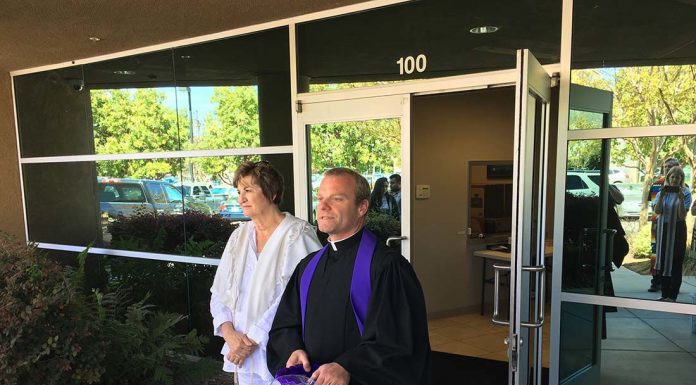
On Holy Thursday, local clergy leaders from numerous faiths represented in South County performed a foot washing ceremony outside the U.S. Immigration and Customs Enforcement (ICE) office in Morgan Hill. It was an effort to “show solidarity” with immigrants who have been removed from their homes and separated from their families by federal agents, according to organizers.
BookSmart writes final chapter

The final chapter of BookSmart may soon be written.Citing mounting debt following a move from downtown Morgan Hill to East Dunne Avenue, BookSmart owners Brad Jones and Cinda Meister face the imminent closure of their Morgan Hill mainstay.“It’s heartbreaking,” Meister said. “This is our passion, to be part of the community and to support literacy and the arts. It’s a safe place for the community to gather. It’s much more than a bookstore.”Friday afternoon, the day after Jones and Meister announced the news of their store closing via email, aggrieved longtime customers came forward to pay their condolences.“A lot of our regulars have come forward asking what they can do,” Jones said.In its 22 years as Morgan Hill’s independent bookstore, BookSmart has cultivated a loyal core of supporters. Last Friday, March 23 those customers were shocked to read an email sent by Jones and Meister announcing their decision to close."It is with heavy hearts we must announce our closing," the message read. "The move to our Dunne location was very costly—financed with high interest and short-term loans. Our effort to refinance this debt has been unsuccessful and therefore we are unable to pay our bills. Starting today, we are liquidating our merchandise to pay our vendors and taxes."The store’s owners estimate BookSmart will be closed within a month or month-and-a-half, unless they receive a sudden infusion of financing from a surprise source.To finance their move in 2016 from downtown Morgan Hill to their current location at 1295 E. Dunne Ave., Jones and Meister ran up what would become a mountain of debt—$250,000 worth.The move, which took almost five months, left a vacuum of revenue. It also broke up the spending habits of former customers who went elsewhere, said the owners. Along with the cost of prepping the new location, the ongoing expenses cut deeper and deeper into the store's economic vitality. Eventually, it became too much to bear, and Jones and Meister said they were forced to bow to the economic reality.BookSmart was also plagued by the cost of rent, which for them is about $7,500 a month. They said they are now five months behind on the rent.More than a bookstoreBookSmart started as a small bookshop in downtown Morgan Hill. Jones and Meister branched out when they soon after added a toy store and a coffee shop to their book retail business. When the opportunity came to move to a larger location, they decided to put all three ideas together into one place at the downtown shopping center known as Depot Center, on East Second Street.“We bought an option to eventually own the property ourselves,” Jones said. “We paid more money up front so we could buy it later. Then, the economy changed and all the opportunities we had to purchase the property evaporated. We brought in some financial partners, but the city eventually bought the option on the property.”Specifically, the city’s Redevelopment Agency purchased BookSmart’s option on their former downtown site in 2010 for $1.7 million. Even though the state shut down the RDA in 2011, state regulators allowed the City of Morgan Hill to keep the option, and later sell it to developer City Ventures in order to complete the RDA’s former vision of modern mixed-use, residential/commercial development on the former Depot Center property and sites throughout the downtown.The old 25,000-square-foot Depot Center building, which had been a number of things in the past—including an egg plant—was also the home of several other local businesses, most of which also relocated out of the downtown neighborhood in 2016 before City Ventures demolished the structure. BookSmart moved to its current, and likely final location in a newer commercial shopping center in east Morgan Hill, near the intersection of East Dunne Avenue and Condit Road.According to Jones, BookSmart received no help during the move.“The city helped the other tenants to move, but in the contract, we signed when we purchased the option to buy the building, we also waived our rights for future relocation,” Jones said.After the move outside the downtown in 2016, BookSmart remained steadfast in its efforts to support community arts and culture. Jones and Meister formed the nonprofit BookSmart Community Advantage program, which has offered fun and educational workshops, art lessons, music classes and more, primarily geared toward children. Without a center of operation, the future of Community Advantage is uncertain and the foundation's board are exploring other options.As downtown Morgan Hill continues to ride a wave of redevelopment and renewal, BookSmart owners feel they have been left high and dry.“I was the president of the downtown association for years, and we really wanted the downtown to be something special, and right on the verge of that happening, we were out,” Jones said.As the crisis loomed, Jones and Meister launched a Gofundme campaign in July which eventually raised $20,000. The also sought financial relief by applying for a loan from the Grow Morgan Hill Fund. Despite support from the city council, their application was rejected since they've been operating at a financial loss for the last two years.“It would take someone to help us refinance the loan. That would mean, $250,000 over 10 years so we could make the monthly payments,” Jones said. “Every payment we make now goes to service the debt and nothing more.”Today, the old home of BookSmart is long gone. The corner of Second Street and Depot Street is now a construction zone, where City Ventures is building its project, consisting of commercial units on the ground floors and a number of “live-work” residences upstairs.And, while Morgan Hill leaps into the future, Jones and Meister will make a similar leap into the unknown.“We don’t know what we’re going to do; we need to find jobs,” said Jones, who was scheduled for a hip replacement surgery at the hospital this week. “We put every penny we had in this, and we put other people’s money into it too. We need to pay them back.”
Photos: Locals protest gun violence

Local activists of all ages joined the nationwide “March For Our Lives” in downtown Morgan Hill Saturday, March 24.
San Martin Pumpkin Park ‘not going anywhere’

According to the owner of the San Martin Pumpkin Park, rumors that the land there has been sold are untrue, and they have no plans to close the popular seasonal destination.“I’ve had friends and family ask me if we’re going to sell it—it’s become quite a stir,” Uesugi Farms General Manager Pete Aiello said. “We’re not going anywhere. We’ve been here a long time, and we hope to be here a lot longer. We know it’s an important piece of the community and if not for Pumpkin Park, people wouldn’t know about Uesugi Farms.”Uesugi Farms has owned the property where Pumpkin Park sits since 2014 along with Rocke Garcia, President of Glenrock Builders. Recently, the Aiello's sold their interest in half of 16 acres of farmland that's adjacent to Olive Avenue in San Martin to Garcia. "That land is not part of Pumpkin Park, and we've been growing vegetables there since 1979," Pete Aiello said.Pumpkin Park, located at 14485 Monterey Road in San Martin, is a 60-acre local fall family fun park, which features a corn maze, train rides, hayrides, a petting zoo, pony rides and, of course, pumpkins. It’s also home to the annual Giant Pumpkin Weigh-Off, where contestants vie for a $25,000 grand prize. In 2013, the contest hosted a then world record 2,032-pound pumpkin.Pumpkin Park has been a family run business since 1985, owned and operated by the Aiello family. According to Pumpkin Park's website, Pumpkin Park draws over 100,000 people each fall, starting when the park opens Oct. 1.
Local realtor receives industry’s Top Producer Award

EXIT Realty Keystone’s Connie Martin, of Morgan Hill, was recently honored with the Top Producer Award by EXIT Realty Keystone, according to a March 13 announcement.
March 24 march against gun violence at CCC

Two local groups, the Morgan Hill Federation of Teachers (MHFT) and Showing Up For Racial Justice South County (SURJ) are co-organizing a March 24 Morgan Hill March for Our Lives in support of gun control.
Rain increases flow to Pajaro
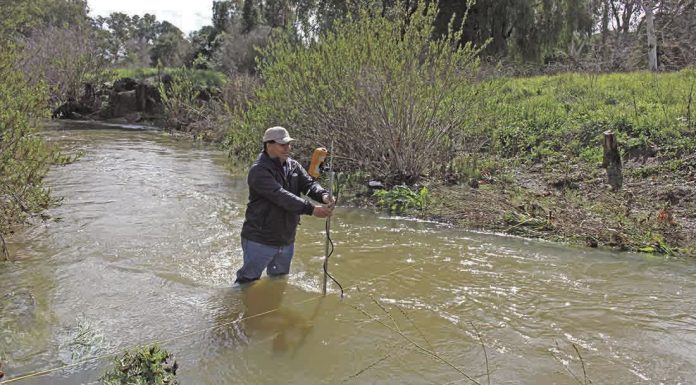
The late-winter rain has been good news for gardeners, farmers and the steelhead.The Santa Clara County Water District sent out teams of hydrographers to streams in the Pajaro River watershed early this month, and initial reports showed streams running at near seasonal levels.One hydrographer at Uvas Creek in Gilroy reported stream flows nine times greater than the previous month. With the recent rains, things are looking up for naturalists, who were concerned that bone-dry January and February would blunt comebacks by several endangered species.The 104-mile Uvas-Llagas watershed flows south, gathering rainwater from the broad valleys of southern Santa Clara County, and meets the Pajaro River in northern San Benito County.The timing of this rain couldn’t have been better, according to Herman Garcia, who had been carefully monitoring endangered species in the watershed for two decades.He waded into Uvas Creek in Gilroy in early March with a water district hydrographer, to get a first-hand look at the flowing water.Garcia said the steelhead (Oncorhynchus mykiss) is set to begin the fish species’ spawning runs this month. For several years, drought conditions prevented that trek from Monterey Bay up streams like Uvas Creek to lay eggs. But the spawning runs returned in 2016 and 2017, after heavy winter rains.Uvas Creek supports one of the last remaining wild runs of the steelhead, which is a federally threatened species that spawns in fresh water for up to two years. The young fish migrate to the ocean where they reach adulthood, and adults return to their natal streams to begin the process again.Garcia said fields in northern San Benito County rely on shallow wells for irrigation, and that the deep aquifers that provide drinking water for much of the region are still in good shape.More than 50 streams flow into Pajaro River, and they need late-winter maintenance, he said.His 15-year-old nonprofit environmental organization, Coastal Habitat Education and Environmental Restoration, hosted a Uvas Creek cleanup on Saturday, March 10 at the Uvas Creek entrance to Christmas Hill Park in Gilroy.The volunteers included high school students who pulled garbage and trash in the creek from Silva’s Crossing to the Santa Teresa Boulevard bridge.The Santa Clara Valley Water District reported that as of March 13, its 10 reservoirs had a combined storage of just 29.4 percent of their full capacity.Founded on donations in 2003, CHEER has negotiated conservation easements along the wide Pajaro River watershed, aiming at restoring habitats. It operates Coastal Watersheds Garbage Museum, a “Mobile Education Unit" that delivers interactive environmental education to local schools and community groups.Steelhead trout are the same fish as the rainbow trout, but the latter spends its entire life in fresh water and the former live a major part of their lives in the Pacific. They look different as adults because of their different diets and environments.Females can lay as many as 10,000 eggs in nests called redds, and, unlike salmon, which die after they spawn, both male and female steelhead return to the ocean and make annual spawning runs, sometimes more than once a year, during lifetimes that can last as many as a dozen or so years. They can grow to between 40 and 50 pounds.In 2006, the Pajaro River was designated America's most endangered river by the American Rivers organization, due to levees constructed by the Army Corps of Engineers along its lower 22 miles (35 km) and severe agricultural runoff into the river.Native California fish present in the lower Pajaro River are: Inland Threespine Stickleback (Gasterosteus aculeatus microcephalus), Sacramento Perch (Archoplites interruptus), Riffle Sculpin (Cottus gulosus), Sacramento Tule Perch (Hysterocarpus traskii traskii), South Central California Coast Steelhead (Oncorhynchus mykiss), and Thicktail Chub (Siphatales crassicauda).
MHCF adds pair of new board members

The Morgan Hill Community Foundation, a nonprofit organization that helps facilitate the issuance of grants to a variety local philanthropic and humanitarian causes, recently added two new members to its board of directors.
Supervisors beef up 2020 census

Knock, knock, Santa Clara County. The county Board of Supervisors has put up $1 million to beef up the upcoming United States Census in 2020, in an effort not only to get a better understanding of the county's demographics but also to pump more federal dollars into the area.
Help clean San Martin at March 24 Trash Bash

Join Santa Clara County Supervisor Mike Wasserman, Santa Clara Valley Water District Director John Varela and residents of San Martin March 24 to volunteer to help clean up your community.The “San Martin Trash Bash” will start 8:30am March 24. Volunteers are asked to meet at the Sig Sanchez Government Center, 80 Highland Ave. The event will occur, rain or shine.Volunteers age 16 and older will be asked to register for the event. Volunteers must sign waivers of liability.Community service hours will be available for students who wish to volunteer, according to a press release. Cleanup supplies and safety gear will be provided. Participants are asked to wear comfortable clothing and shoes.To RSVP, email [email protected] or sign up on Facebook by searching for the page “San Martin Trash Bash.”The cleanup event is sponsored by the San Martin Neighborhood Alliance, Santa Clara County, GreenWaste, SCVWD and the San Martin Chamber of Commerce.

