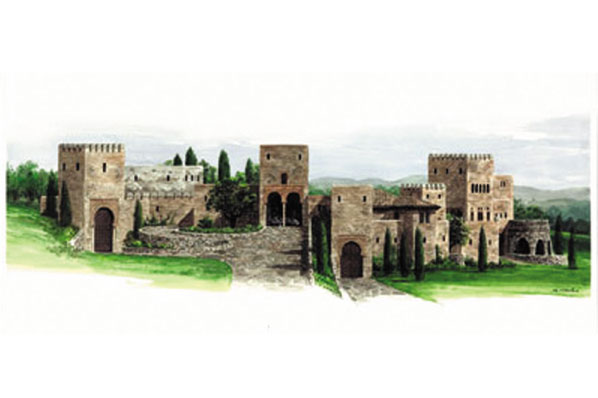
There are landslide victories, but can there be landslide ties?
Three area geologist firms can’t agree on whether or not a
square-mile landslide could clobber the castle that the American
Institute of Mathematics plans to build as its new
headquarters.
There are landslide victories, but can there be landslide ties?
Three area geologist firms can’t agree on whether or not a square-mile landslide could clobber the castle that the American Institute of Mathematics plans to build as its new headquarters.
If they can come to an agreement this week then the 10-year-old plans could finally get the city’s go ahead.
The site for the castle is the southeast corner of Foothill and Maple avenues east of U.S. 101. This happens to be situated at the southwest tip of South Santa Clara County’s largest developed landslide. At issue is whether development there will “reactivate” the long dormant landslide.
AIM’s geologist Dr. Rex Upp of Upp Technologies gives the castle the stamp of approval, and used data gathered from the 200-square-foot graded pit there to determine that. But city geologist Dr. Peter Anderson of Pacific Geotechnical says Upp’s study is flawed and more study is needed. A second peer review by Cotton, Shires and Associates found similar conclusions. The city won’t issue a building permit until the geologist study meets local and state code, and both reviewers argue that Upp’s study does not.
This is the latest in a slew of setbacks for the math institute and electronics magnate and institute founder John Fry. In 1998, the city discovered that Fry had begun redesigning the Institute Golf Course without permits. Both the golf course project and the castle-cum-AIM headquarters adjacent to it have been mired in scrutiny from the city and environmental groups since.
After lengthy reports to the City Council from both camps Wednesday night, frustrated AIM officials told the council that they wouldn’t support, financially or otherwise, further study.
Equally frustrated Councilman Larry Carr told them that “that’s not how the process works.
“The applicant doesn’t do a study, and then we get a peer review and the applicant rejects that and tells us, ‘Just give us our permit’ and then we just roll over and do that. There are two parties and there’s a dispute and I wouldn’t support the city bearing all the cost of doing that.”
His peers seemed more willing to financially support further study. The city has paid the second peer reviewer, Cotton Shires, $2,400. AIM will pay $15,000 to Pacific Geotechnical. They’ve paid $8,500 toward that so far.
This is the largest landslide with development on it in South County. The Rancho Robles housing development of about 40 homes are located atop the slide. PG&E built an interstate pipeline on it. AIM Executive Director Brian Conrey said if it’s fit for PG&E, then why not AIM?
But Anderson said a lot has changed since the homes and pipeline were built. The state requires more geologic investigation and analysis before proving that a hillside is stable enough to support development, he said.
“In our professional opinion, (Upp’s) report did not conform with the requirements made out by state law,” Anderson said. “I completely trust in Upp Geotechnology’s integrity. But it is our judgment that this work effort that he did fell short of the mark. We have our job to do, for public safety, to make sure the codes are followed.”
Conrey said AIM paid $50,000 for a “perfectly good geology report” by the well-credentialed Upp.
“We’ve spent more than 10 years trying to get this project done, with the environmental issues, and we’ve been through quite a number of different hurdles to get this project done, and just when it looked like we (can get started) we’re asked to do a geology report.”
Conrey said AIM officials don’t support further study because the foundation planned for the pit, a 5-feet-thick concrete mat, is the strongest foundation that could possibly be built, so there is no further mitigation possible. Either the city allows the castle to be built, or it doesn’t, he said. And it seems both AIM and the city really want the castle to happen, he said.
Conrey said the continually delayed project could wind up being a personal and professional embarrassment, as the ongoing stalls could influence both the International Math Union’s consideration of Morgan Hill for its official headquarters and the National Science Foundation’s funding, which lends worldwide credibility to the math institute. Conrey said science foundation officials continually ask what’s going on in Morgan Hill.
“They talk about it all the time. It’s very much in their minds,” he said. Foundation officials will come to the Bay Area next year for a site study at AIM’s current headquarters in Palo Alto as part of the foundation’s ongoing grants. The status of the math castle will be central to their talks, Conrey said. And if there’s no end in sight to the delays, “We’re going to have an awful lot of explaining to do,” he said.
The geologist study is required before a building permit is issued, but was not required for the grading permit that created the existing pit.
Upp and Anderson agree on one thing: this 200-square-foot pit that is 40 feet deep at points makes the landslide less stable than it otherwise would be. The concrete foundation will remedy that, Upp said. But they can’t fill the hole without the permit.
The council will receive an update from staff Wednesday, pending the meeting of Upp and Anderson. The two hoped to meet today or Wednesday, but had yet to schedule a meeting by press time Monday.