

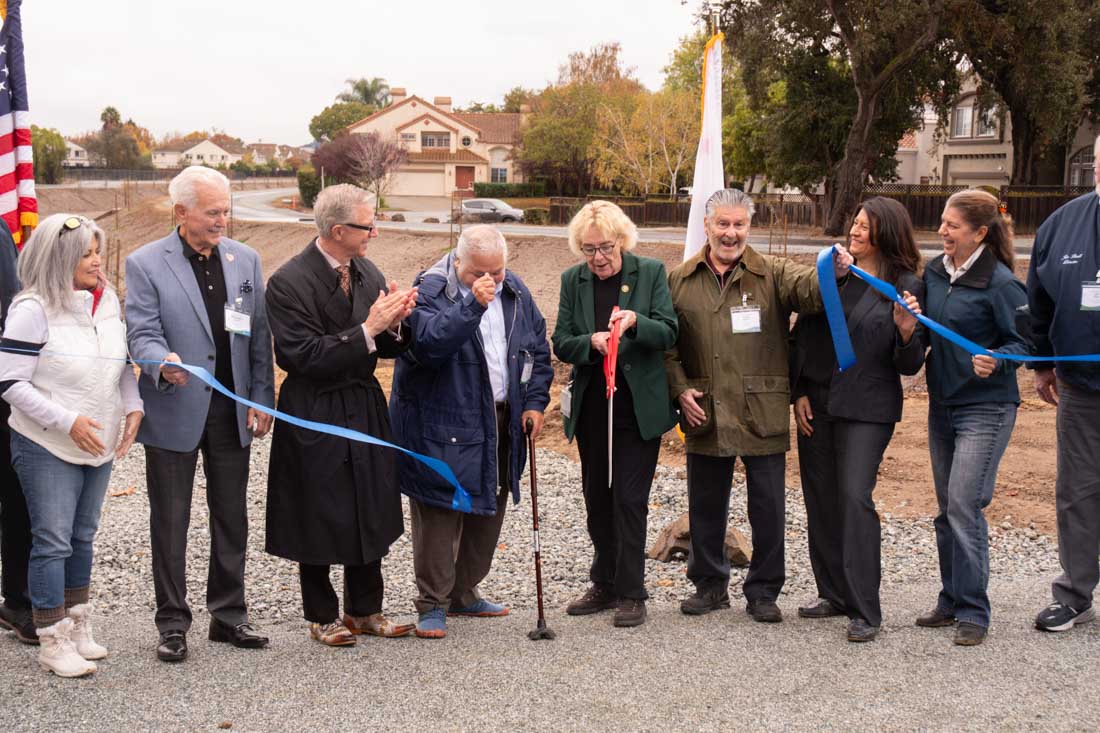
The weather cleared just long enough to allow local, state and federal officials to cut the ribbon on the completed Upper Llagas Creek Flood Protection Project Nov. 16, a $176.2 million South County effort that took about 70 years to plan, fund and build.
“Not a day too soon, as you can see by the weather surroundings,” said Rachael Gibson, Valley Water’s chief of external affairs.
The project consists of 13.9 miles of flood protection improvements along Llagas Creek, West Little Llagas Creek and East Little Llagas Creek in Morgan Hill, Gilroy and unincorporated San Martin. Valley Water says the work protects about 1,100 homes, 500 businesses and more than 1,300 acres of farmland from a potential 100-year flood.
The final phase, which began in October 2024, included about eight miles of improvements from Highway 101 upstream to Llagas Road, where crews widened and deepened channels, improved crossings and installed underground culverts.
Earlier phases included a 2,300-foot tunnel beneath downtown Morgan Hill and wetland habitat at Lake Silveira. Graniterock Co. was the construction contractor.
The project began as a federal effort led by the U.S. Army Corps of Engineers that stalled for years due to a lack of funding. Valley Water began pushing it forward about a decade ago.
Valley Water Board Chair Tony Estremera said at the ribbon cutting ceremony at La Crosse Drive and Vineyard Boulevard in Morgan Hill that the agency promised in 1954 to build the project and chose to pay for it locally after the Corps stepped out.
“We promised as an agency since 1954 to do this project when the Corps stepped out,” Estremera said. “Our agency decided that we would do it with local funding.”
“Getting a project of this magnitude done is not very easy, as many of you might know,” he said. “Our first partners were the voters who approved the Safe, Clean Water and Natural Flood Protection Program.”
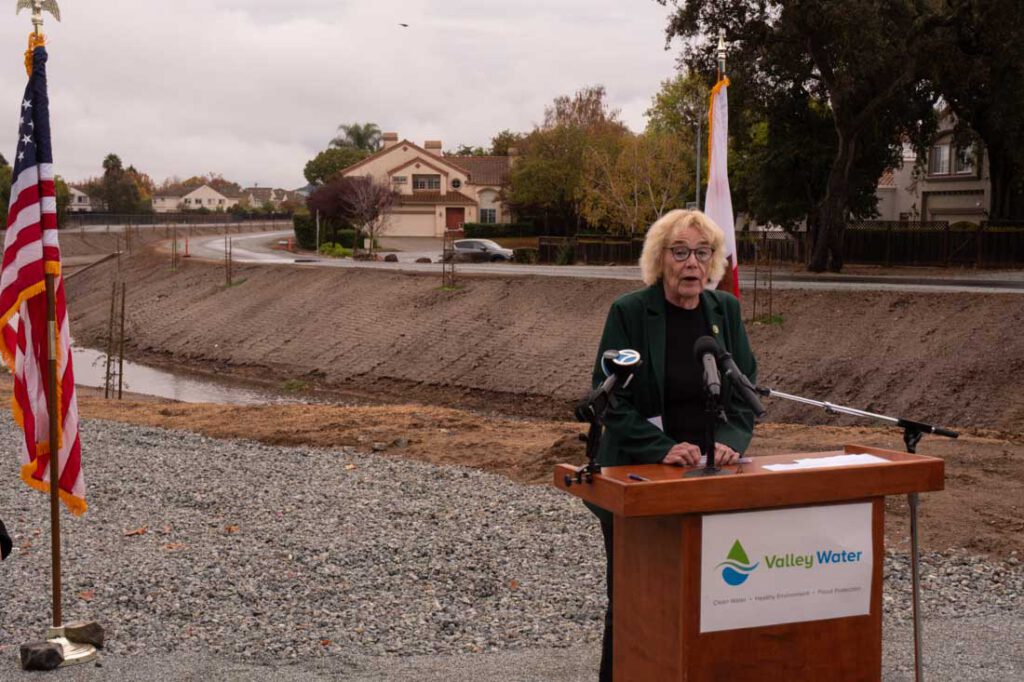
Rep. Zoe Lofgren said she learned about the stalled project soon after taking office in 1995. She helped secure an $80 million federal grant from the Natural Resources Conservation Service two years ago to close the funding gap.
“I am so delighted that it’s done in time to meet this year’s El Niño,” Lofgren said. “I never gave up, and neither did you.”
Funding also came from Valley Water’s voter-approved Safe, Clean Water and Natural Flood Protection Program, the California Department of Water Resources, and the City of Morgan Hill.
Morgan Hill Mayor Mark Turner said many people had wondered whether the day would ever come.
“Businesses can invest with increased competence,” Turner said. “Future development can occur with greater certainty, and many residents may ultimately see relief from flood control related insurance requirements and costs, creating meaningful financial benefits for households throughout our community.”
City officials have said the project is expected to remove a number of Morgan Hill neighborhoods from Federal Emergency Management Agency flood maps. Streets including Watsonville Road, Main Avenue and Wright Avenue have flooded repeatedly during heavy rain.
Valley Water Director John L. Varela, who represents Morgan Hill, recalled the November 2019 groundbreaking.
“I remember when we gathered, not so far away from where we were here, in November of 2019 for the groundbreaking of this project,” Varela said. “Since then, our agency, working together with partners, has delivered flood protection improvements. We don’t know what El Niño will bring, but rest assured that this project is ready to do its part to help this community to be safe.”
Six of Valley Water’s seven board members attended the ceremony. “That really is testament to how important this project is,” Gibson said.
Valley Water said the improvements are complete and operating. Remaining restoration work, including replanting the disturbed soil with native plants, is scheduled to finish by March 2027, followed by a three-year plant maintenance period through spring 2030.