

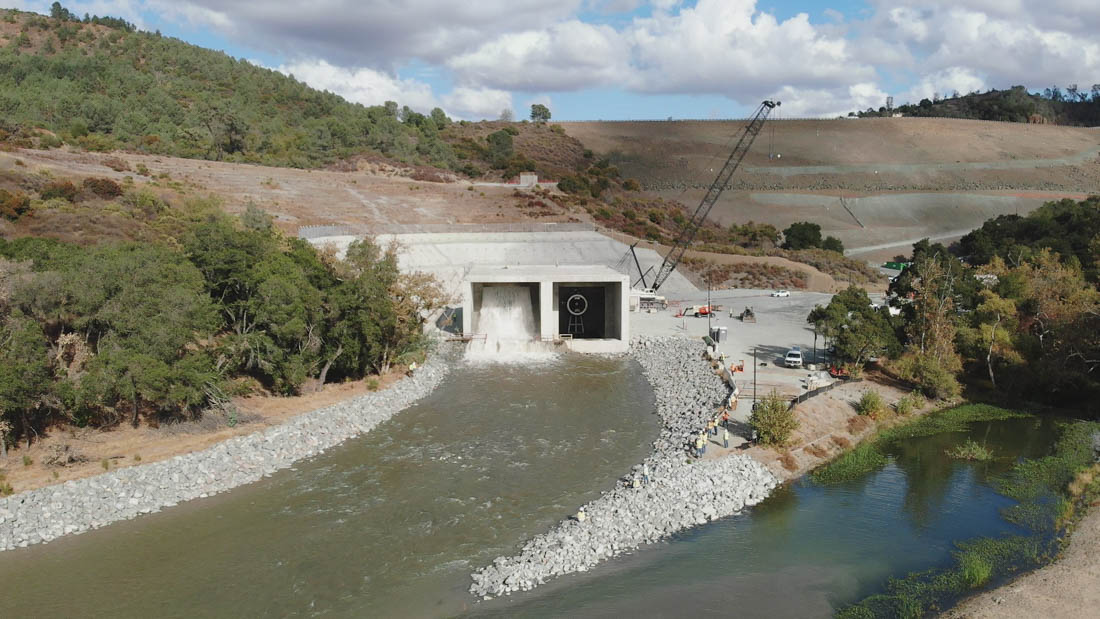
Valley Water on Oct. 30 released water from Anderson Reservoir into Coyote Creek through its new Anderson Dam tunnel for the first time, a step that clears the way for the dam’s seismic retrofit project to begin.
Contractors opened the tunnel’s two fixed cone valves one at a time to 10% of capacity, according to a Nov. 9 Valley Water statement. About 4 million gallons, enough to fill roughly six Olympic-sized swimming pools, passed through the 1,736-foot tunnel.
The tunnel will allow Valley Water to control reservoir levels during construction and heavy rain, an essential first step before the full seismic retrofit process could begin. With a strong El Niño possible this winter, the agency said it will use the tunnel as needed to keep the reservoir at its 3% restriction.
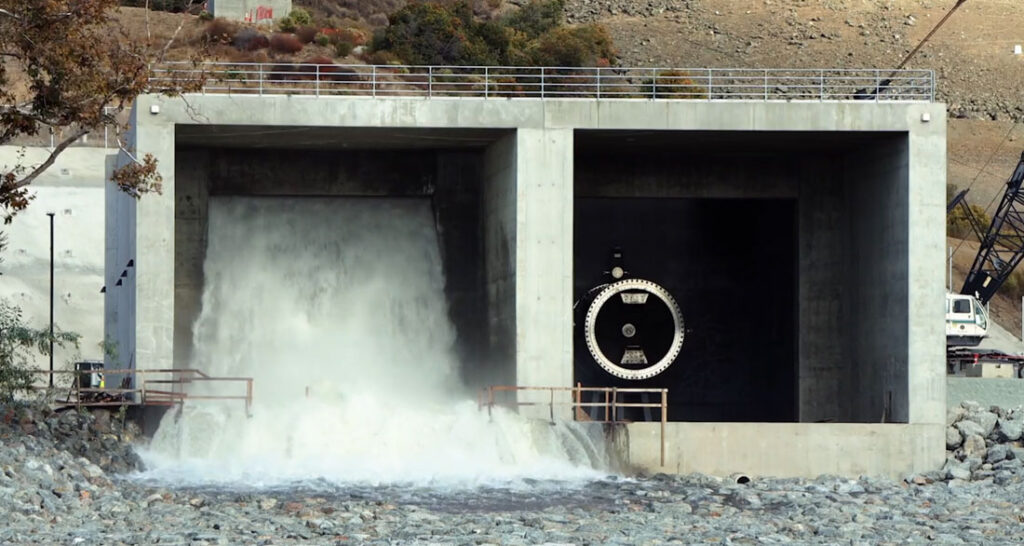
“That was pretty exciting for all of us who’ve been working on the project for a number of years, seeing water go through that tunnel for the first time,” said Deputy Operating Officer Ryan McCarter.
Construction on the $1.88 billion project will intensify in 2027 with the construction of haul roads, temporary bridges and additional tunneling to expand release capacity, the agency said. From 2028-2032, crews will rebuild the dam and spillway, install new outlet pipes and complete seismic upgrades.
Embankment construction is expected to finish in 2032, followed by site restoration through 2033.
“Rebuilding Anderson Dam is an investment in the safety of our communities and the reliability of our water supply,” Valley Water Director John Varela, whose district includes the dam, said in a press release.
Valley Water officials outlined the schedule and took questions from residents during a public meeting Nov. 5 at the Community and Cultural Center in Morgan Hill.
McCarter, who led the presentation, said the first year of work includes a 130-foot-deep shaft for a second diversion tunnel. Meanwhile, the dam will gradually be lowered year by year before being reconstructed from the ground up.
The project is expected to see operations restored at Anderson Reservoir in late 2032 or 2033, with restoration work continuing through 2034 and final project acceptance expected in 2035.
Residents voiced concern at the public meeting that the completion date for the massive project has already slipped several years since it began, and asked whether the new estimate includes possible additional delays.
McCarter said the timeline is based on a best-case scenario and could see further slippage if critical milestones are delayed by weather or other unforeseen obstacles.
“Each one of these [annual] phases is almost a project in itself,” McCarter said, explaining that the project needs to meet certain milestones every year before seasonal rainfall begins. “If it doesn’t, we’ll lose an entire year.”
McCarter said the 1950s-era dam is vulnerable to earthquake liquefaction because builders compacted the material poorly.
“What they did wrong in 1950 is they put the material in large lifts, 35-foot layers, as tall as this ceiling, with very little compaction,” he said. Saturated material like that can liquefy in a strong quake, he said.
The new dam is designed to withstand at least a 7.2-magnitude earthquake on the nearby Calaveras Fault.
Residents, particularly from the Holiday Lake Estates neighborhood, took the opportunity at the Nov. 5 meeting to press officials on noise, night hauling and lighting. One man said the recent work has left him disillusioned after previously being assured by officials that impacts would be addressed.
“It’s been unbearable for four months, hearing constant beeping, really, for 12 hours a day,” the resident said. “If this is any indication of what’s going to happen for the next seven years, I’d be really concerned about the rest of the neighborhood.”
The concerns were echoed by multiple residents of the neighborhoods near the project.
“You can’t have all these trucks and tractors going beep, beep, beep, beep all night long, all summer long, for six or seven years,” another resident said. “You’re going to have lawsuits, you’re going to have delays.”
McCarter said backup alarms are a federal safety requirement, and noted that stockpiles and haul roads were “hundreds of feet away from homes.”
“There has to be a noise. It’s an OSHA requirement,” he said. “We’re working through those plans right now and taking that into consideration, to limit that as much as we can around the neighborhoods where there are homes, and doing night work. We want to avoid it as much as we can.”
Valley Water will continue to hold public meetings every six months during construction.
For more information on the project, visit tinyurl.com/4ykszvc9.