

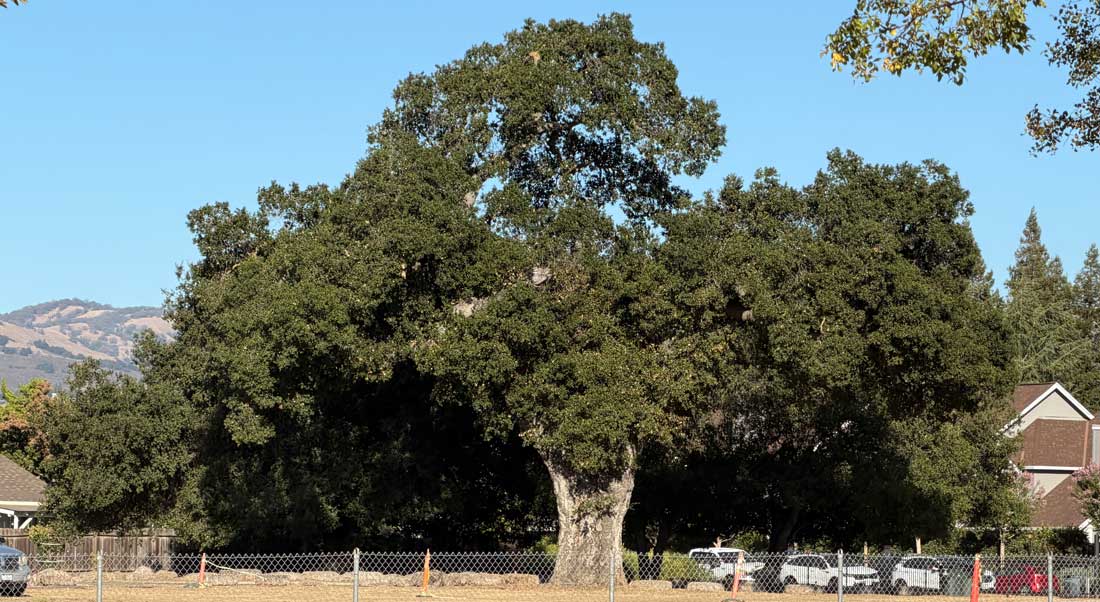
Morgan Hill residents are pressing the city and housing developer Valley Oak Partners LLC to change plans for a 93-unit housing project so that a massive Coast Live Oak, thought by some to be among the largest and oldest trees in Morgan Hill, is not cut down.
The tree stands at Diana Avenue and Butterfield Boulevard on the site of the Diana-Valley Oak project, a planned development on roughly five acres at 375 Diana Ave. The city council approved the project in July 2025.
Plans call for removing the tree and three other significant oaks beside it, according to Lisa Voss, the resident who began the campaign. The tree is believed to be hundreds of years old.
Assistant City Manager for Community Development Edith Ramirez said city staff have passed residents’ concerns to the development team and are talking with the developer about options. She said any redesign would be entirely up to the developer, who is not required to make changes because the entitlements are secured. She said it was too early to describe a specific path forward.
“The developer is at the table,” Ramirez said. She said the city has received numerous emails and letters expressing “tremendous concern” about the trees.
The tree’s exact age has not yet been credibly established. Lesley Miles, a Morgan Hill-based architect with a horticulture degree from Cal Poly, estimates it is at least 200 years old and possibly older. She said a photograph from 1913 already shows a large tree at the site. Voss said the city never commissioned an in-depth arborist assessment.
The push to save the tree spawned from a Nextdoor post by Voss after seeing the development notice at the corner and reading the project page. Voss then wrote to the mayor and other city officials. She said they explained that the trees needed to be removed to accommodate a driveway setback from the nearby intersection.
Voss was not the only resident to raise the alarm over fears of losing the tree. Mayor Mark Turner said multiple residents had raised concerns with him directly, and he has indicated to the city manager that “we need to do everything we can to keep from cutting these trees down.”
“I too feel strongly about preserving them,” Turner said. “While we don’t have a lot of say over the amount of housing we are mandated to build, we should do all we can to preserve oak trees wherever possible.”
Opponents of the project also argue that the city’s environmental review of the project under the California Environmental Quality Act was inadequate because it did not properly evaluate the oak as a potential Historical Resource.
Miles, who heads up local architectural firm Weston Miles Architects alongside husband Charles Weston, said they drew up an alternative site plan that keeps the oaks and the same number of units, and sent it to the city. She said building around mature trees is common practice and, under Morgan Hill’s past growth-control process, earned developers points.
“When we had our growth control process in Morgan Hill, it was not just an environmental concern—it became a priority because you would actually get points for saving trees and incorporating them into the design concept,” Miles said. “You go to many other communities, and the heritage trees really add to the design of the project.”
That local point system, however, has been overridden in recent years by state laws that prioritize housing density over other development and growth concerns.
The developer must apply for a tree removal permit before the trees can be cut, Ramirez said. She said the city likely cannot deny the permit because the developer has the right to build, though the permit would carry mitigation requirements.
The city’s significant trees ordinance calls for replacing each removed protected tree with a native tree at least 15 gallons in size, and allows the development services director to require additional trees to offset larger amounts of lost canopy area.
“The developer has secured entitlements, so a redesign is a big ask,” Ramirez said. “It’s really completely at the goodwill of the developer.”






Typical of Morgan hill . Cut down paradise and put up a parking lot. The valley here used to be full of apricot trees, prune trees, almond trees. All gone due to reckless development by the Morgan hill city council, and the state legislature’s mandated housing.
One very important issue deserves clarification from the City. Morgan Hill Municipal Code §12.32.070(A)(7) specifically addresses whether “all practical design alternatives for site layout have been exhausted without being able to design around the tree(s).”
As this article reports, the tree-removal permit has NOT yet been issued, and an alternative design has now been submitted that preserves these oaks while maintaining all 93 housing units.
So how can the City say that approval of the tree-removal permit is likely unavoidable without first addressing the requirements of its own tree ordinance and evaluating the 93-unit alternative?
The underlying arborist information is also important. These four oaks were described as vigorous, with concerns involving structure rather than a determination that they must be removed because of disease. Yet the developer’s plan labels the exceptionally large oak “diseased.”
Morgan Hill can have the 93 homes AND seriously evaluate preservation of these extraordinary trees. Before a tree-removal permit is issued, the City should explain which §12.32.070 finding supports removal of each tree and how it determined that practical design alternatives have been exhausted.