When Jasper Jonnalagadda spotted what he believed were American badger burrows in a Coyote Creek canyon in December 2023, the then-15-year-old photographer was determined to find a way to capture the elusive native carnivore.
His pursuit would encounter multiple obstacles including expensive permits, technical problems, logistical delays and dozens of fruitless trips into the field. But his efforts ultimately earned him nearly 300 volunteer hours, a special projects role with Santa Clara County Parks and Recreation and official recognition for his efforts at the county’s annual volunteer appreciation luncheon April 25.
“He’s gifted, for sure, and extremely smart,” said Roberto Romero, senior park ranger at Coyote Creek Parkway. “The whole thing is his: the idea, the locations, the recordings, finding the data, everything.”
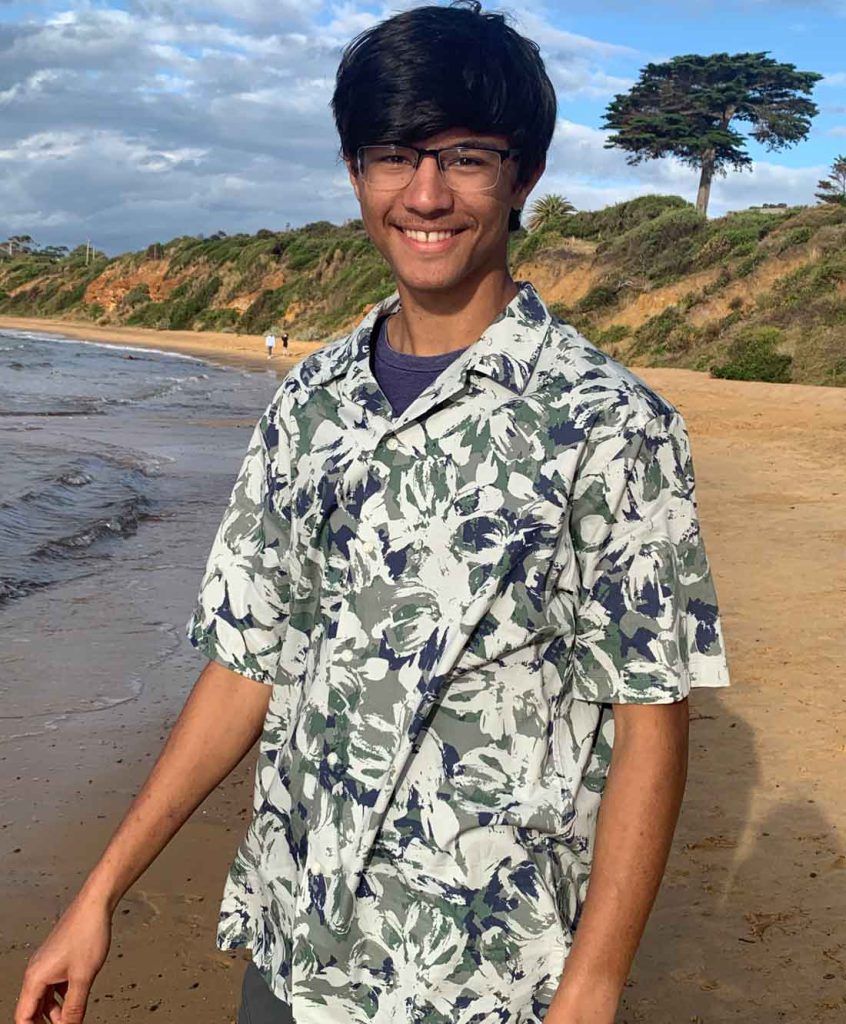
Jonnalagadda, now 17, set out initially to photograph badgers on his own, but when he learned that a filming permit could cost him hundreds of dollars per day, he decided to take a different route.
After approaching park rangers at the Coyote Creek Visitor Center, he worked his way into a volunteer role that eventually gave him the access he needed while also providing park rangers with unique and difficult-to-obtain wildlife data and public outreach material.
“When we get young people or teens who want to assist with something, they’re often really passionate about it at first, but they don’t necessarily follow through,” said Michelle Armijo, Parks Program Coordinator for Interpretation and Education at Santa Clara County Parks and Recreation.
“Life gets in the way, or other obligations, other time commitments,” she said. “But with Jasper, every project he’s said he was going to work on, he’s come through 100 percent. He’s truly been a part of our team. He volunteers in the Visitor Center, talks with the public about the park, and his footage goes not just to our biologist but to outside agencies as well.”
Even with the rangers’ support, Jonnalagadda’s initial efforts were a struggle. His first attempt to access the site of the badger burrows was delayed for months by logistical concerns.
When he finally got a camera into position in late July 2024, he found he had set the sensitivity too high after the memory card filled up within three hours, capturing nothing but wind-blown grass. He returned six weeks later to find the camera’s last recorded timestamp was the day he had put it up.
“A hard lesson to learn,” he said, “and it happened several more times.”
The cameras work by detecting changes in infrared radiation emitted by warm-bodied animals, but this means a gust of hot air can trigger them just as easily as a passing badger. Calibrating this sensitivity, as well as identifying landscape features that funnel animal movement, turned out to be crucial learning curves.
“When you look at the videos, you see how animals use the same path over and over again,” Jonnalagadda said. “Eventually you start spotting that more easily.”
Once he had learned to identify these natural bottlenecks, such as a gap in a barbed-wire fence or a narrow canyon crossing, his work began to bear fruit, with the cameras yielding photos of coyotes, jackrabbits, wild boar, gray foxes, bobcats and mountain lions.
One early clip appeared to show a female mountain lion with two cubs, their eyes glowing just beyond the reach of the camera’s light.
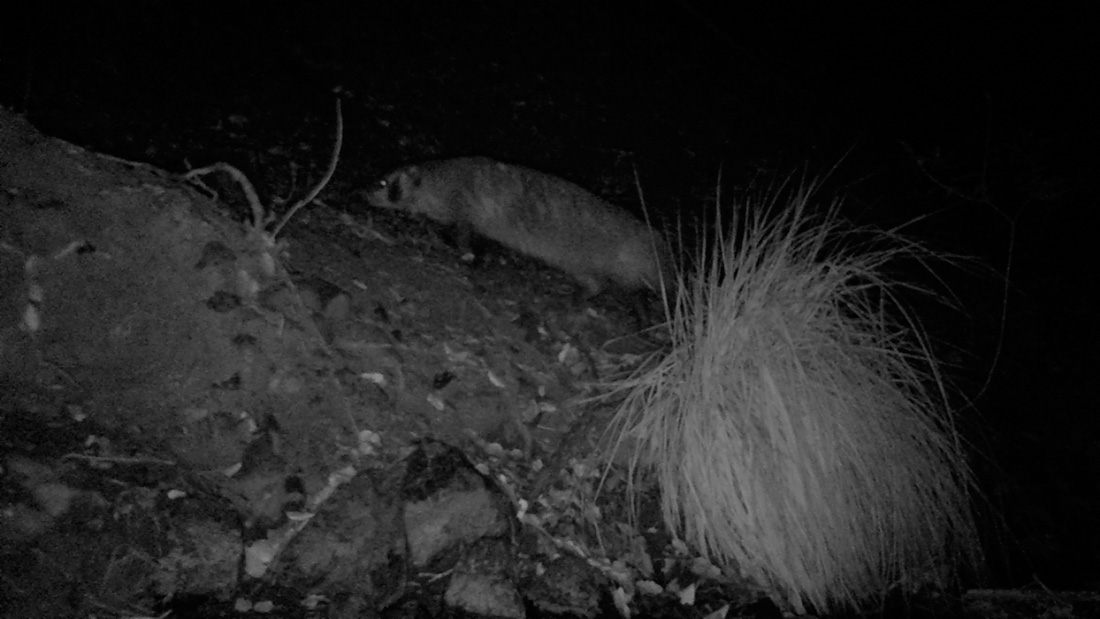
Finally, after nearly two years, Jonnalagadda found the thing he had been searching for: the elusive American badger—not at the burrow site he had been monitoring, but at a stream crossing more than a mile away where he had been capturing images of mountain lions.
“I don’t think my parents or sisters ever saw me get so excited,” he said.
The footage has since been shared with outside agencies studying wildlife corridors in the region. Park staff have also used his videos and images in interpretive displays at the Visitor Center and in public outreach on topics ranging from invasive feral pigs to nocturnal predator behavior.
“We always relay some kind of interpretive message with the footage he provides,” Armijo said. “We have truly benefited from his efforts and his passion.”
Beyond the cameras, Jonnalagadda monitors and cleans both bird and bat nest boxes throughout the parkway, and assists rangers in various tasks both in the field and at the office. He has also created wildlife illustrations that hang in the Visitor Center offices, including drawings of a coyote, a rattlesnake and a kingsnake.
“His love of nature comes across in multiple ways,” Armijo said. “Photography, filming and he’s an exceptional artist as well.”
Jonnalagadda is one of nearly 3,000 volunteers who contribute more than 35,000 hours annually across Santa Clara County Parks. Armijo said she hopes someone steps up to continue the trail camera work when Jonnalagadda eventually heads off to college.
“We know he’ll be applying to colleges soon, and we definitely wish him the best, even knowing we may lose him as a volunteer,” she said. “But the things he’s contributed here will be reused many times over to educate the public about the parks and the natural world around them. Hopefully we can find someone to continue his trail camera project.”
Residents interested in volunteering with Santa Clara County Parks can find information at parkhere.org. Jonnalagadda’s wildlife observations featuring hundreds of species of native animals are posted on iNaturalist under the username JJ1228.