There’s a French expression,
”
ch
âteaus en Espagne.
”
It means
”
castles in Spain
”
or
”
castles in the air;
”
put plainly: fanciful daydreams. American Institute of
Mathematics officials insist that their planned headquarters,
modeled after a Spanish castle, doesn’t fit this particular
profile.
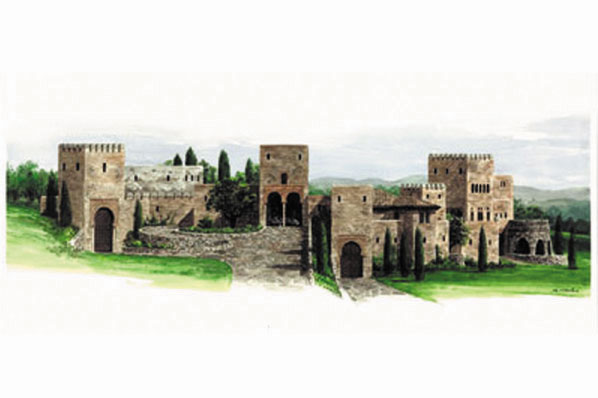
There’s a French expression, “châteaus en Espagne.” It means “castles in Spain” or “castles in the air;” put plainly: fanciful daydreams. American Institute of Mathematics officials insist that their planned headquarters, modeled after a Spanish castle, doesn’t fit this particular profile.
The castle’s planners have seen setbacks, including the current conflict over a geology report necessary for the institute to receive its foundation permit.
Still, despite what some city officials suspect to be an unwillingness to cooperate, Fry’s Electronics spokesman Manny Valerio, speaking on behalf of institute founder John Fry, said neither the institute nor Fry had any plans to call it quits.
“AIM and Fry are very firmly committed to being located in Morgan Hill. Differences in opinion should not be construed as a lack of desire to be located in Morgan Hill,” Valerio said. “The fact that there are some items to be worked out, that does not mean there is a lack of desire.”
In 1998, the city discovered that Fry had begun redesigning his private Institute Golf Course without permits. Both the golf course project and the castle-cum-AIM headquarters adjacent to it have been mired in scrutiny from the city and environmental groups since.
Institute Executive Director Brian Conrey said he assumed everything was full steam ahead.
“As soon as the foundation permit is issued, we’re going to start building the foundation,” he said, adding that construction would likely take about two years.
“It’s a huge prestige factor,” Conrey continued. “Having a national math institute here, it makes Morgan Hill that much more desirable to live in.”
When companies relocate here, Conrey said the institute will be at the top of the list of boastables, and realtors will tell their clients about it.
“There are a number of people in the community who are friends of AIM, and want to see it be established in Morgan Hill, and are excited, ecstatic, supportive and eager to see AIM finally come to fruition,” Valerio said.
For about 10 years, Institute officials have planned to build their headquarters adjacent to the golf course on the southeast corner of Foothill and Maple avenues east of U.S. 101. Features of the sprawling 178,000-square-foot facility include 21 hotel-style rooms, 20 offices, a 144-seat lecture hall and a theater for special events or lectures.
Many amenities that the city’s businesses could provide the hundreds of annual visitors are, then, spoken for by the facility itself. And, according to Santa Clara County Association of Realtors Government Affairs Director Anil Babbar, the institute’s affect on property values is difficult to measure.
“It’s an unknown. There’s nothing comparable,” Babbar said.
Babbar said it’s hard to quantify whether the institute’s events would effect property values, either.
“Does the Gilroy Garlic Festival have an effect? It’s not really quantifiable,” Babbar said.
But that doesn’t mean the institute, which will attract the “creme de la creme” of the international math community, doesn’t provide a certain “je ne sais quoi” that the city is excited about.
Appreciating the cachet that can’t be quantified, city officials directed city staff in July to pen a developer’s agreement to ascertain the when and how that will bring the ornate castle to Morgan Hill. They hope the agreement will lock in a timeline and squelch any potential for further delay.
The project is currently stalled at the foundation permit stage after the institute’s geologist and the city’s two geologists disagreed about the amount of research needed to study the impact of building the castle on a dormant landslide there.
City Attorney Danny Wan and the institute’s attorney Tessa McFarland are working on this issue, and, once settled, the institute will get the foundation permit and much of the battle will have already been fought.
“This is just sort of a logistical agreement, of when and how much,” Wan said. For example, city and institute officials were still working on the geological issue.
“They certainly understand that they need to do more study. But we need to agree on what the proper scope is,” Wan said.
Unlike traditional developers agreements, which are crafted by the city when residential development is proposed to balance the impacts of construction with added infrastructure, such as roads and parks, this document will outline the scope, infrastructure and timeline of the rest of the project itself, including the scope of the geological work left to be done, how much infrastructure is expected to be built into the project and the expected timeline.
Even without concessions like promised parks, officials laud the castle coming to town.
What it lacks in sales tax revenues, Conrey says the castle makes up for in worldwide prestige.
City officials agree.
“The interest it will generate from visitors around the world, the cachet that it will bring as one of the premier institutes of the world, it will change how Morgan Hill is considered,” Councilman Greg Sellers said. “There’s more potential economic development, and we may see other types of development that would have never happened.”
Conrey said, too, that the institute’s commitment to community events like the Math Mardi Gras boost the educational wow factor for parents.
“In a time when schools are so poorly funded, it’s just a great thing for the focus on students at the upper end who have a talent in math,” he said, listing James Gamborg and Mark Holmstrom as two students who have won regional competitions after earning their chops at the annual, local Math Mardi Gras.
“I see them going on to become mathematicians,” Conrey said.
The current headquarters of the institute, which is backed financially by the National Science Foundation, is a warehouse in Palo Alto.
So, city and institute officials alike hope the developer’s agreement will provide the “savoir faire” needed to keep the project rolling, and, “voila!”, a castle will be born in Morgan Hill.