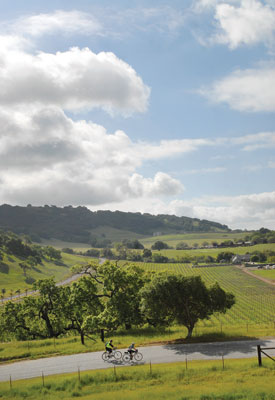
More than 2,000 bicyclists will roll through Morgan Hill and
Gilroy Saturday on their way to completing up to a 120-mile loop in
the 32nd annual Tierra Bella Bicycle Tour, coordinated by the
Almaden Cycle Touring Club.
More than 2,000 bicyclists will roll through Morgan Hill and Gilroy Saturday on their way to completing up to a 120-mile loop in the 32nd annual Tierra Bella Bicycle Tour, coordinated by the Almaden Cycle Touring Club.
One of the lead organizers of the tour this year is Penny Carl of Morgan Hill, who became president of the San Jose-based, 900-member club in January. Carl first started cycling about five years ago, and now rides her bike at least 40 to 50 miles a week. She has even completed two “centuries,” or 100-mile-plus rides.
Perhaps the most impressive thing about Carl’s active riding schedule is not that she started cycling when she was 60 years
old and a grandmother of two. Carl, who now rides more than 2,000 miles a year, has rheumatoid arthritis, a chronic disorder that causes inflammation of the joints. The condition can cause extreme pain and can even be disabling for some patients, and one reason Carl became so addicted to cycling is the low-impact sport doesn’t cause as much pain as other activities she enjoyed prior to her diagnosis about four years ago.
“I used to play golf, but it started to hurt my hands. I can’t do fast walking because it hurts my feet. Cycling is easy on your joints,” Carl said.
About 2003 was when the pain in her extremities began and became more frequent, Carl said, and she repeatedly visited her general practitioner with swollen hands and feet wondering what was wrong. Finally, she went to a rheumatologist, Dr. Gerlie Papillion in Gilroy, who diagnosed her with the ailment whose onset most commonly occurs in women older than 50.
Papillion said Carl has had an “excellent response” to the regular treatment and therapy she receives.
The reason is that Carl is “pretty close to being perfect” when it comes to her understanding of her condition, and the need to combine physical therapy, a good diet, exercise, and stress-reducing habits in her overall treatment regimen, Papillion said.
“After her diagnosis she became much more aware of the benefits of exercise and she began biking,” said the doctor. “It’s not common for rheumatoid arthritis patients to be active. (The patient’s response to the condition) depends on a person’s personality, and drive and understanding that they have some control over their disease.”
Carl possesses those traits, and Papillion said that’s why her disease is in remission and she no longer suffers any joint inflammation. As a result, Carl is able to function normally, unlike many sufferers of rheumatoid arthritis, Papillion said.
Carl was introduced to cycling by a friend of hers, who brought her to her first ACTC meeting in 2004. Initially “devastated” by her diagnosis, Carl said she didn’t think she would like cycling at first. However, she was moved by the friendliness of other club members.
“It’s been history ever since,” Carl said. She immediately enrolled in the club’s 10-week academy that teaches bicycle repairs and riding techniques. The next year she ran for club vice president, and now some of her best friends are ACTC members.
“It’s my social life,” she explained.
The medication regime that Carl still undergoes sounds intolerable, and consists of a chemotherapy infusion every seven weeks. But she said she mingles with other patients during each session, and the treatment at Papillion’s office is almost like a support group.
“I actually look forward to going (to the doctor) now,” Carl said.
Aside from the long-established benefits of regular exercise, Carl explained good cardiovascular health is especially therapeutic for rheumatoid arthritis patients.
“Physical activity contributes to muscle strength, which gives the joints the strength they need to function,” Papillion said.
The Tierra Bella Tour is one of the cycling club’s two main fundraisers each year, collecting registration fees to pay for the nonprofit group’s sponsorship of other activities.
The tour offers a choice of four routes for pre-registered riders. The options range in length from about 37 miles to about 120 miles, and with varying levels of vertical ascent. All four routes will twist through different locations in Gilroy, and the two longer ones will bring a line of cyclists through downtown Morgan Hill before trudging up to the entrance to Henry Coe Park at the end of East Dunne Avenue, and then gliding back down.
This past Saturday, Carl and about 100 other volunteers who will not ride in the Tour but will instead help with directions and rest stops for the 2,000 cyclists, did a pre-ride along the official route. The volunteers made sure the roads were still open and directional signs were accurate.
Carl looked like she hadn’t even broken a sweat at an end-of-the-ride barbecue at Gilroy’s Las Animas Park.
Though she started cycling as a way to get needed exercise and to treat her medical condition, Carl now gets a thrill out of the accomplishment she feels at the end of a particularly strenuous route. She also enjoys the camaraderie of the activity.
“My biggest joy was a year ago on Mother’s Day, when I took a ride with my daughter and granddaughter on the Coyote Creek Trail” in northeast Morgan Hill. “I was so proud we had three generations cycling together.”