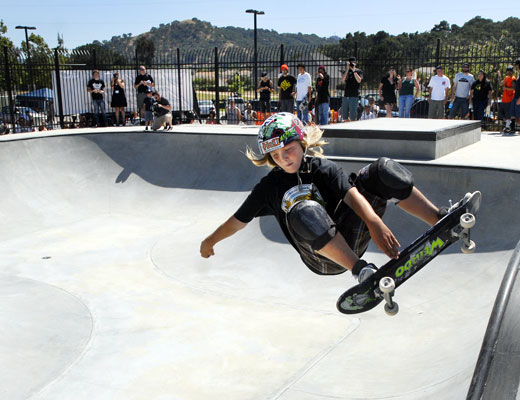
The city wasn’t quite prepared for the entourage of skate kids
at the newly opened skate park at the Centennial Recreation
Center.
”
It’s a different community, with a lot of strong
personalities,
”
said recreation program coordinator Chiquy Mejia. So since the
onslaught of skaters sans helmets hit, city officials haven’t known
what to do to enforce, without staff, their
”
helmets required
”
policy.
The city wasn’t quite prepared for the entourage of skate kids at the newly opened skate park at the Centennial Recreation Center.
“It’s a different community, with a lot of strong personalities,” said recreation program coordinator Chiquy Mejia.
So since the onslaught of skaters sans helmets hit, city officials haven’t known what to do to enforce, without staff, their “helmets required” policy.
“We’ve tried several different things. We’ve closed it to everyone, even those with helmets. We’re now just kicking out the people who aren’t wearing the equipment. That’s worked, but they just come back,” Recreation Manager Chris Ghione said.
The skaters say they just don’t want to wear a helmet. With temperatures peaking in the mid-90s this week, it’s too hot. Helmets make them skate worse: it limits their visibility and throws off their balance, they say. And, the older, 13- and 14-year-old skaters say they know how to fall. And, there have been no injuries so far, they say.
“When you fall, you mainly slide and get right back up,” Daniel Stanco, 14, said. “You know how to not hit your head.”
Eighteen-year-old Matthew Dokter’s head trauma after his April spill at the park was a fluke, a dumb mistake Dokter made, the skaters said. Dokter trespassed onto the unopened park and was hospitalized with head injuries.
The city opened the park on June 27. The recreation department doesn’t have the staff to man the park, which is open about 10 hours daily, so the helmet policy is difficult to enforce, officials say.
The Morgan Hill Police Department has an officer stopping by once a day, doling out tickets that start at $100 for the first offense, and go up to $500 for the third.
It’s had an effect, but not the intended one, Mejia said. There aren’t more skaters with helmets, there are just fewer skaters visiting the park, she said.
“We’ll just go skate behind buildings,” Stanco, 14, said. “The city’s the one that spent ($600,000) on this park. If they want to close it, it’s their loss.”
The skaters had a seemingly simple solution: have everybody sign a waiver. If they don’t wear a helmet, the city won’t be held liable for any injuries, they reasoned.
Ghione said that’s not an easy fix. For a waiver to work, the city would have to have someone there to make sure all the users without safety equipment had signed a waiver. As with the helmet rule, there’s no manpower to enforce that.
While recreation leaders scratch their heads for a solution, Ghione said the city is focusing on getting adult skaters – the 18- to 30-year-olds – to set an example for the younger ones.
Justin Yannone, 34, of Aromas, visited the park for the first time Tuesday afternoon. He was decked out in full safety gear: helmet, elbow pads and knee pads.
“I’m just wearing these to avoid financial ruin,” Yannone said. “It just makes sense. I drive safely because I don’t want to crash my car. It’s the same thing. I just gotta be careful.”
Were the half dozen skaters gathered round Yannone convinced?
“No,” they said in unison. Nothing will make them wear helmets, they said, although some kept helmets in their backpacks or along the fencing – just in case a police officer showed up and started ticketing.
Yannone chuckled at their defiance.
“When I was younger, I wasn’t as smart. It’s hard to teach people. I was the same way,” he said.