The round and unobtrusive tranquility projected by El Toro Mountain as it lazes over the west side of Morgan Hill belies the disruption, nuisance and turmoil that a legal hiking trail up its face might introduce into the quiet neighborhoods surrounding the peak, according to residents who plan to continue to fight the City’s plan to develop such a route.
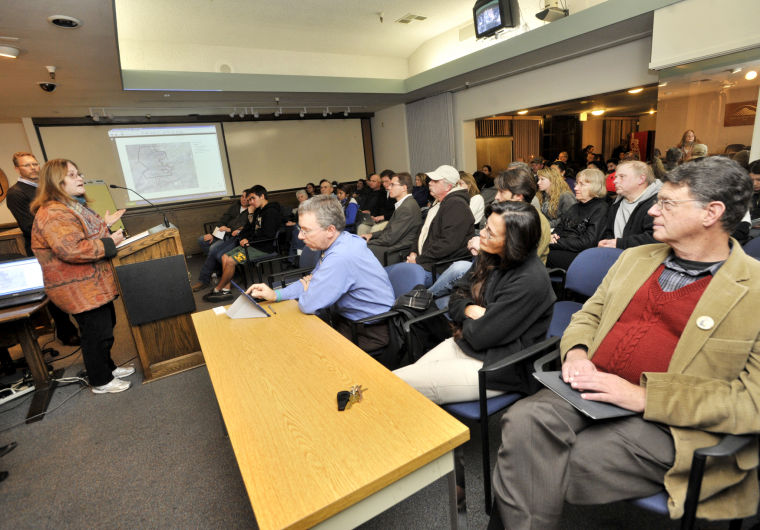
At a Morgan Hill Parks and Recreation workshop at City Hall Tuesday, residents listed a variety of impacts they already see in their west Morgan Hill neighborhood due to El Toro’s frequent (and largely illegal) use as a hiking destination, which they fear will only multiply in the future if the City sanctions, builds and advertises a formal trail as it has planned for more than 10 years.
Worries stem from the threat of parked vehicles jamming up the street, litter, loitering, noise, traffic and other impacts. Small children live in some of the homes on Via Grande, and some of their parents noted Tuesday that as the trail has become more popular, it is more dangerous for their kids to play outside.
“You’ll get all kinds of riffraff,” Via Grande resident Jenene Brewer said.
“It’s the wrong place” for an official trailhead, she added.
First proposed in 2002 as part of the City’s trails and natural resources study, development of the trail will be divided into two phases if approved by the Council. The first phase of the trail would utilize public land already owned by the City and the Santa Clara County Open Space Authority.
The second phase would require the purchase of more property at the summit, which is privately owned but has been illegally accessed by hikers for decades. City staff currently estimate the total project cost at about $820,000.
The Phase One, 1.9-mile trail network could include new trailheads – one at the end of Via Grande and one near the parking lot of West Hills Church on DeWitt Avenue – which would be connected by a winding dirt trail that traverses the eastern face of El Toro Mountain. The summit is about 1,400 feet above sea level, and the existing half-mile trail climbs from the end of Via Grande mostly in a straight line and at a steep grade.
There is no defined schedule for the project’s progress, including when it will appear before the Council for approval. But City staff said they will continue to engage residents about their concerns and consider alternatives to the current plans.
One potential mitigator, according to City staff, is to use the Morgan Hill Library’s parking lot and restroom for trail users, in addition to building an informational kiosk and shade structure in the lot. Gittleson noted there are more than 270 public parking spots on City property in the vicinity of the library that trail users could use. The parking lot is about 1,500 feet from the end of Via Grande.
Residents at Tuesday’s workshop, however, doubted that all hikers would use the City’s parking lots if they can find a spot at the end of a cul-de-sac just next to the trailhead. Plus, the library itself is crowded on Saturdays, and closed on Sundays, eliminating the use of the restrooms.
The need for a public trail up El Toro Mountain, the oddly shaped hill formerly known as Murphy’s Peak, has been portrayed cursorily with a survey of hikers who visited the existing trail last summer.
The survey, conducted by City-hired Bellinger Foster Steinmetz architects, found that on a Saturday between 8 a.m. and 6 p.m., about 70 hikers embarked toward the top of El Toro, according to City staff. Most of those were local residents, and most indicated they have hiked up El Toro multiple times previously.
“Our concern is when it’s really a public trail, those numbers are going to get much higher,” said Via Grande resident Joe McMorrow at Tuesday’s workshop. “This is a quiet, safe neighborhood. We all have small children. Do we need (a trail) in our backyard? Do we need to disrupt these quiet neighborhoods?”
He added that the residents will continue to fight the El Toro project. He and other residents have collected 50 signatures so far opposing a public trailhead on Via Grande.
Authorities do not have a method of predicting how many hikers the trail would draw once it is formalized and listed in public directories and websites as an official recreational site, Morgan Hill Associate Engineer Dave Gittleson said.
By comparison, at the Rancho Canada del Oro open space preserve, which is in south San Jose, OSA staff estimate about 27 people use the hiking trails each weekday, and about 54 on weekend days.
The Open Space Authority cites the El Toro Trail project as part of its “urban open space” program. The OSA’s mission is to purchase such properties in order to preserve them forever as open space, restore wildlife habitat and provide recreational opportunities to residents.
The existing, illegal trail up El Toro is “very steep,” and its poached use over the years has resulted in environmental impacts and “severe erosion,” according to OSA general manager Andrea Mackenzie.
“El Toro Mountain is an iconic feature in Morgan Hill, and in the South County,” Mackenzie said.
Anecdotally, hikers’ need for an authorized trail up El Toro is apparent and fair, according to hikers and other Morgan Hill residents.
Ron Erskine, a hiker and avid outdoors enthusiast who writes an ongoing column about the subject for this newspaper, lives on West Dunne Avenue at the bottom of El Toro Mountain.
He guessed that currently, most people who climb El Toro access the existing trail through his street, and he has seen “considerable” foot traffic on the way to El Toro some days. Erskine said the hill is “sitting there beckoning people.”
“It’s just such an obvious landmark, and it’s an attraction that a lot of people can’t resist,” Erskine said. “The view is stunning. On a clear day, I can see the financial district in San Francisco, the Bay Bridge, and Mount Tamalpais.”
Another Morgan Hill resident, Doug Muirhead, who does not live on the way up El Toro, suggested at Tuesday’s meeting that the concerns of a single neighborhood should not be allowed to affect a project that could be a “win-win” for the wider community.
“When you have a legal trail, and legal users, some of this unwanted behavior goes away,” Muirhead said. “The rest of us in this city think we have some rights, too, to access trails, parks or open space.”
Erskine added that in his experience hikers in general – and specifically those who climb El Toro – cannot be “associated with the criminal element.”
He said everyone he has encountered on their way up to the peak has been “friendly, and kind,” and he too thinks that more hikers on a formal trail would help preserve the tranquility of the area.
The Open Space Authority is leading the property acquisition for the El Toro project’s second phase, but they have a policy of only working with “willing sellers,” OSA staff said at Tuesday’s workshop.
OSA Director Alex Kennett, who attended Tuesday’s meeting, said the acquisition of the property will be complicated because at the top of El Toro is “a corner of three different properties,” owned by different owners.
“The three families have been more than happy to deal with us,” Kennett said. “The question is whether we buy the land outright, or (obtain) an easement.”
One of the owners – Mark Good, a trustee for the Gilroy Unified School District whose family has owned property on El Toro for decades – said he was unaware of the three corners where the privately owned parcels meet, and he has not been contacted by the OSA or entered into any negotiations to sell the property.
Good said he and his family have firsthand experience with trail poachers being uncivil.
Good, whose family owns the western side of El Toro that includes the summit, said in the past year he has seen a rise in trespassing and vandalism – including graffiti, litter and damage to trees. He thinks just by talking about developing a trail, the City has invited more traffic to El Toro.
“Arguably, the City has created a nuisance by building a trail to get to a parcel of property that people have no legal right to go to,” Good said.