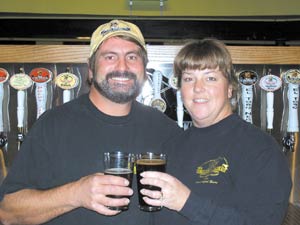
A $400,000 loan to help El Toro Brew Pub pay off construction
overruns was preliminarily approved by the Morgan Hill
Redevelopment Agency on Wednesday.
Morgan Hill – A $400,000 loan to help El Toro Brew Pub pay off construction overruns was preliminarily approved by the Morgan Hill Redevelopment Agency on Wednesday.
The city council, acting as the RDA’s directors, voted 4-1 to approve the loan after the restaurants’ owners, Geno and Cindy Acevedo, claimed unforeseen construction costs sent them over-budget last year.
The couple invested $1 million in equity and $1.9 million in loans from Heritage Bank to purchase and remodel the old Morgan Hill police station, where the restaurant opened last November.
Cindy Acevedo said the RDA loan would allow her and her husband to pay contractors for work completed last fall. While her husband said “time is of the essence” to secure additional funding, Cindy declined to say what might happen should the Acevedos not receive the RDA’s help.
“We’ve brought a $3-million project to the city,” she said, justifying the loan request. “We employ 50 people and have a lot of customers who say they truly enjoy the business.”
City Councilman Greg Sellers, who voted in 2003 to award the original project to the Acevedos after the couple said they wouldn’t need RDA funds, voted against issuing the loan. Sellers said he enjoys the restaurant and hopes it can thrive, but he wanted to be true to his initial reasoning.
“I felt it would be hypocritical of me to vote to give them additional funds when the deciding factor for me was the original financial deal,” Sellers wrote in an e-mail after the meeting. “Having said that, I am impressed with the project and will do everything I can to help them succeed.”
The Acevedos, who launched El Toro Brewing Company in 1994, said unforeseen dry-rot, seismic upgrades and roof work, among other things, resulted in construction overruns.
Fortunately, they said, business is going well, exceeding their projections.
But because their venture does not fit the U.S. Small Business Administration’s guidelines for a guaranteed loan, and because Heritage Bank could not tolerate a higher loan-to-value risk on a single-use building, the Acevedos are seeking financing through the RDA.
“We’re sort of at a nexus,” Geno said, explaining why the pub doesn’t yet qualify for small-business financing. “We’re not a start-up, but we haven’t been a restaurant long enough to receive an SBA loan.”
The Acevedos received from the city approval to work out a three-year loan with requirement to refinance within 12 months. The owners will sit down with Heritage Bank and city officials to work out the precise terms and conditions in the coming weeks. The final loan agreement will come back to the city council, possibly in May, for another vote.
“One of the great things about the RDA is we can give loans like this that will be paid back so we can then help other businesses,” said City Councilwoman Marby Lee.
City Councilman Larry Carr said he understands how the construction overruns caught the Acevedos off guard.
“This is a building no one knew what it would take to renovate,” Carr said. “And it took more than anyone, including us, thought.”
It’s possible for the RDA to make loans to private businesses as long as the financing supports the agency’s goals. The RDA’s primary objective is to fund projects that revitalize “blighted” neighborhoods and business districts.
The RDA’s efforts to help businesses also include a Commercial Rehabilitation Loan Program and grants for improving building facades.
The $400,000 loan to El Toro Brew Pub isn’t the first of its kind. In recent years, the agency has issued a five-year, $350,000 loan to Charles Weston and Lesley Miles, owners of Weston Miles Architects, Inc., for the purchase of the Granary on Depot Street.
Additionally, the RDA issued a $350,000 loan and a $112,000 “facade grant” for the Gunter Bros. renovation project on Monterey Street north of Main Avenue. The project is being developed as a three-story office building with ground-floor commercial space, second-floor offices and third-floor residential units.