While the Morgan Hill Unified School District is outperforming
the state as a whole, school officials are questioning the clarity
of the picture given by recent test results.
Morgan Hill – While the Morgan Hill Unified School District is outperforming the state as a whole, school officials are questioning the clarity of the picture given by recent test results.
The nearly 9,000-student district has seen academic growth that’s greater than the statewide numbers, according to a schools accountability report released Tuesday by Esther Corral-Carlson, coordinator of assessment for the district. The district’s Academic Performance Index has exceeded the state API since 2003 and has gone up by 22 points since that year.
For 2007, the district’s API is 758, while the state’s is 743. In 2003, the state’s API was 705, while the district’s was 736. In 2004, the numbers were 710 and 741, respectively, and they increased to 729 and 755 the next year, then to 740 and 764 by 2006.
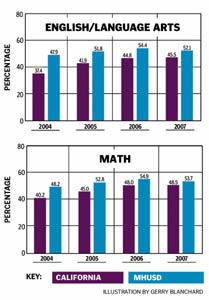
The district’s scores in English and math also top the state’s averages. The percentage of students scoring at the “proficient” level or above for both subjects is greater than the percentage of students across the state scoring at the same level. The district saw a slight dip which could have been related, Correl-Carlson told trustees, to an increase in the number of students taking algebra 1 because more are now taking the course at an earlier grade level.
The report presented to school trustees includes all the elements used to determine Adequate Yearly Progress, or AYP, for the district. The AYP is an important measure used to determine a district’s status under the federal “No Child Left Behind Act.”
Individual schools are also measured by their AYP.
The elements included in the AYP are standardized tests, a student participation rate in 2007 of 95 of percent or greater, a percentage of students that score at the “proficient” level or above in English and math, schoolwide graduation rates and schoolwide growth in Academic Performance Index.
Trustees questioned whether students, particularly secondary students, take this testing seriously. Trustee Bart Fisher asked if the testing is “tied to” anything, such as a student’s grade or to graduation.
The testing is not, although the high school exit exam is required to graduate.
Morgan Hill Federation of Teachers President Donna Foster said teachers attempt to convey to students how serious the testing is, but she acknowledged that some students simply don’t recognize what effect the test scores can have on the schools and the district.
“These are some of the problems and limitations of NCLB, so much around funding and punitive actions, for example, that are not linked to UC or CSU standards,” she said Thursday. “When the kids have to perform for the SATs and the exit exam, it is very clear that we have very bright kids, they have extremely high rate of passage on exit exam, we have qualified more and more students for college, and more and more are accepted.”
Teachers work hard, she added, to make sure the students show up for testing, and said that most of them are cooperative and do their best on the tests.
Foster said though she has not researched the idea, she doubted if it would be legal to make students face a “double jeopardy,” since they already have to pass the high school exit exam in order to graduate.
Instead, Foster added, she believes it would be more productive for board members to focus on creating a resolution to send to Congress on the ramifications faced by the district and other districts because of the “No Child Left Behind” requirements.
“We all want accountability, nobody is afraid of accountability, but we are deeply concerned about the ramifications of this kind of unrealistic measurement,” she said. “It’s an arbitrary percentage, instead of showing growth. Burnett Elementary is the perfect example. They increased their scores by 10 percent, but they won’t be able to get out of (Program Improvement). What many people don’t realize is that it takes just one child (to qualify a school for Program Improvement).”
Trustee Don Moody said that he would encourage parents who are looking at schools to seek out more information than just the school’s test scores.
The district has three schools that are in the second year of Program Improvement status, Burnett Elementary, Jackson Elementary and P.A. Walsh Elementary. The federal “No Child Left Behind” defines a PI school as one that has not met the required percentage increases in each subgroup. For example, Hispanic students, Asian student, English learner students are some of the subgroups that NCLB recognizes.