Drivers in Morgan Hill are long on complaints and short on
patience when it comes to soaring gas prices
– up to $4.25 on average in the San Jose region.
Drivers in Morgan Hill are long on complaints and short on patience when it comes to soaring gas prices – up to $4.25 on average in the San Jose region.
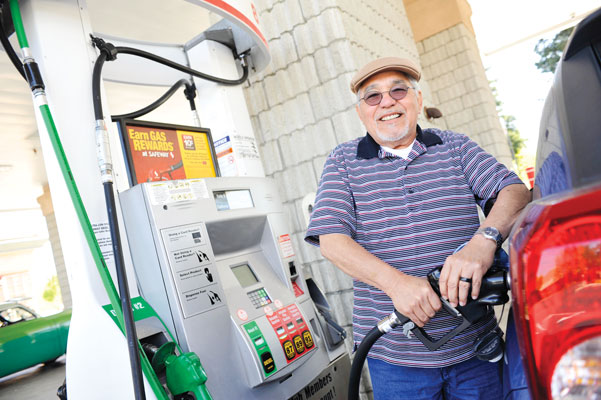
“We’re trying to keep up with these prices,” said Rudy Barraza, a retired principal in East San Jose. Barraza was gassing up at Safeway’s station on Tennant Avenue Wednesday afternoon.
“I’m a senior citizen and I’m on limited income and this is a killer here. You know the fact is, it eats into my beer fund and I really don’t like that,” he said lowering his voice. “I remember when it was 27 cents a gallon. That’s when they made ships out of wood.”
At Safeway, the lines were three-cars deep at 2 p.m. as shoppers took advantage of the 10-cent per gallon discount the grocery store offers its card carriers.
“All right! Only $44 this time. Whoa! What are we going to do with the money left over?” Barraza said before getting into his blue Dodge Caliber and driving away.
As gas prices soar, the area’s mass transit systems have seen increases in riders – the link isn’t scientific, but drivers feeling the pain at the pump are trying to consolidate trips, cut back on road trips and carpool if possible, just as train riders look for ways to save on gas and stress.
Lori Cardona hopped on Caltrain 10 months ago after a stressful and taxing two-hour commute to Santa Clara one day.
“The nice thing is I know exactly how long it’s going to take to get to work,” she said after stepping onto the Morgan Hill platform Wednesday night after work.
“If it’s raining, if there’s an accident, or some other surprise … there’s too much uncertainty in driving,” Cardona said. She said her stress level was too high when she was behind the wheel.
At South County’s three Caltrain stations, ridership figures are steady or rising: Morgan Hill added eight riders this year (113 riders), San Martin added no new riders to its 45 and Gilroy added four new riders (124). Bay Area-wide the numbers pack a bigger punch – up to 41,442 from 36,778 last year – especially important to Caltrain riders and supporters since in April 2010 Caltrain’s board was considering eliminating several lines and shutting down South County’s stations. The agency has been trying to fill a $30-million budget deficit and decided April 21 to retain all 86 trains but raise fares and parking fees.
Caltrain spokeswoman Christine Dunn said the agency doesn’t keep statistics on gas prices related to ridership increases, but the popularity of taking the train is growing.
“It’s at an all-time high. The highest it’s ever been,” Dunn said.
For Cardona, the shift to becoming a passenger posed a greater incentive thanks to her company offering a subsidy for a portion of her monthly pass.
“Even if gas were to go down, I would still take the train,” she said. “I’m able to catch up on so many things – personal email, Facebook, reading. I’m going to be driving as little as possible from now on.”
The price for a gallon of unleaded gasoline is creeping toward the $4.58 price it hit in the summer of 2008. San Jose resident and daily Gilroy commuter, George Bumb III, said $5 is right around the corner.
Road trips are going to take a backseat to Bumb’s budget this summer.
“Oh, heck yeah. My parents live by Lake Clear near Napa; it takes about three-and-a-half hours from San Jose,” where Bumb lives. “We usually go once or twice during the summer but I don’t know if we will go this year because of the gas prices.”
Because of his job in construction, Bumb relies on his Ford F250 pick-up to haul supplies. The truck gets 12 miles to the gallon and he said he spends about $75 every three days.
“They suck,” Bumb said about gas prices. “I have to drive for work and I need this truck.”
The attendant at the Safeway station even agreed: “yeah … they suck.”
Across town at the East Dunne Avenue station Gas & Shop, 1st Sgt. Ken Mattingly of the U.S. Army, in uniform, stopped in Morgan Hill to fill up his Jeep before heading back to Camp Roberts near Paso Robles. He makes a 3.5 hour commute from his home in Suisun City twice a week.
“Gas takes a toll,” Mattingly said. “It affects all things. What you spend on gas, now you don’t have money to do what you did. You don’t get to go out or go to water parks or Great America. We’re so dependent on our vehicles … I don’t have a choice.”
In most states, drivers won’t see prices higher than $4 quite yet as the current national average hangs around $3.88. Last year at this time it was about $2.80.
Live Oak senior Graham Prell – who pays for his own gas – said if it reaches $5.50, he might have to forego driving his Mazda altogether.
“I just put in what I can afford,” he said, adding $10.92 to the tank. “It’s rough.”